THE SENIOR DOG KITCHEN
NUTRITION · SENIOR DOGS
Three Things I Wish Every Owner Of An Older Dog Knew Before They Buy Another Bag Of Food
The word "senior" on the bag is not a standard. Nobody defines it. And when a dog starts slowing down, the change most owners make is, as often as not, the wrong direction.
There is a particular evening when it lands.
Your dog is on the rug, and they don't get up when you come in. Nothing is wrong. They lift their head, their tail goes twice, and they stay exactly where they are. And you find yourself standing in your own kitchen doing quiet arithmetic about how old they are now.
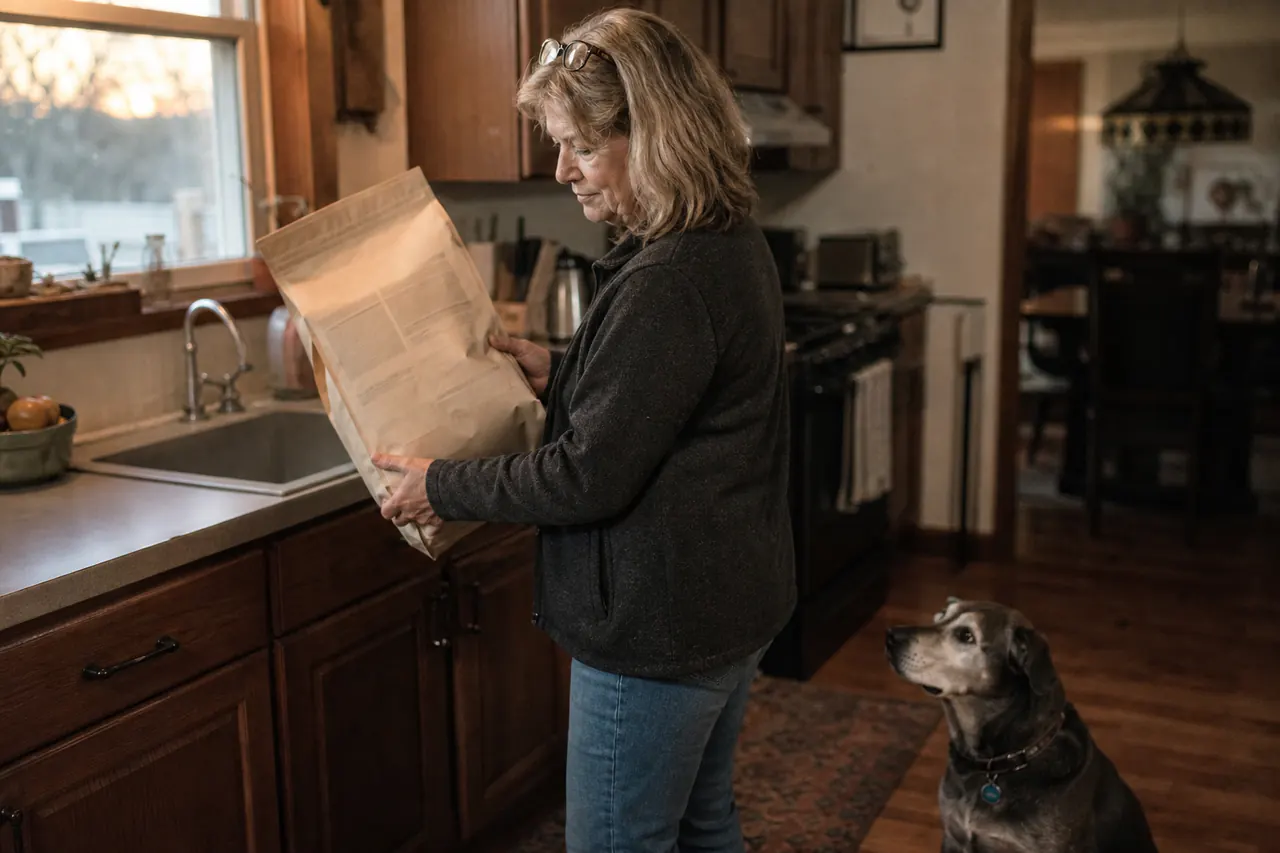
If you have an older dog you know that arithmetic. And you have probably already made the one move nearly everybody makes. You stood in the pet aisle, you saw the bag with the grey-faced dog on the front and the word SENIOR across it, and you bought it.
It felt like doing something.
I want to tell you three things about that bag. None of them are what I expected to be telling people when I started in canine nutrition.
I'll be straight about what's well established and what isn't, because a great deal of what gets said about old dogs and food is said with far more confidence than the evidence supports. Including, sometimes, by people in my own profession.
And at the end I'll tell you what I do instead, because I stopped trusting that aisle a long time ago and I had to put something in its place.
One. "Senior" is not a category. It's a word on a bag.
Here is the thing almost nobody outside veterinary nutrition knows.
There is no regulatory definition of senior dog food. None.
AAFCO, the body whose statement appears in small print on the back of every bag in that aisle, publishes nutrient profiles for exactly two life stages: growth and reproduction, and adult maintenance. That is the entire list. There is no third profile.
The 2023 AAHA Senior Care Guidelines state it in one flat sentence:
"The Association of American Feed Control Officials does not currently have guidelines for senior nutrition."
2023 AAHA Senior Care Guidelines
And a 2025 analysis in Frontiers in Veterinary Science puts it more plainly still:
"Neither the Association of American Feed Control Officials (AAFCO), nor the National Research Council (NRC) have established a definition for senior life stage."
Frontiers in Veterinary Science, 2025
Sit with what that implies. A manufacturer can print SENIOR on a bag, and there is no standard that word is required to meet. It isn't a claim. It's a photograph of a grey-faced dog.
So what is actually in those bags?
That 2025 paper is the reason I now raise this during appointments.
The researchers took 61 dry diets from 25 brands. Thirty were labeled for adult dogs. Thirty-one were labeled for seniors. They ran the numbers on all of them.
The median protein content of the senior foods was 76 grams per 1,000 calories.
The median protein content of the adult foods was also 76 grams per 1,000 calories.
Identical. Statistically indistinguishable.
But medians hide the part that matters, which is the spread:
Adult foods ranged from 62 to 128 grams of protein per 1,000 calories. Senior foods ranged from 52 to 116.
So on a single shelf, all wearing the same word, sit foods that differ from one another by more than twofold. And the senior range starts lower than the adult range does.
The authors' own summary of the differences between the two groups was that they were "inconsistent."
One more finding from that study, which I would rather you heard from me than found out some other way: 18% of the 61 products, eleven of them, failed to meet at least one requirement for AAFCO adult maintenance.
Now, I am not telling you the senior aisle is a scam. Some of those foods are genuinely excellent and I recommend commercial diets to clients every week I work.
What I'm telling you is narrower, and much more useful:
But you cannot find out what's in the bowl by reading the bag either, and I want to be specific about why.
The number I just gave you, grams of protein per 1,000 calories, is the one that lets you compare two foods against each other. It is not printed on any bag. What is printed is the guaranteed analysis, and that gives you crude protein as a percentage, listed as a minimum rather than as what is actually in the food. To get to something you can compare, you have to find the calorie statement, do the conversion yourself, and then accept that you are working from a floor and not a real number.
I do that arithmetic because it is part of my job. I have never once met an owner doing it in a pet aisle on a Saturday afternoon, and I would not ask you to.
So the aisle is asking you to choose between products it will not let you compare.
Two. A lot of what you're calling age is muscle. And muscle answers to protein.
This is the part I actually care about.
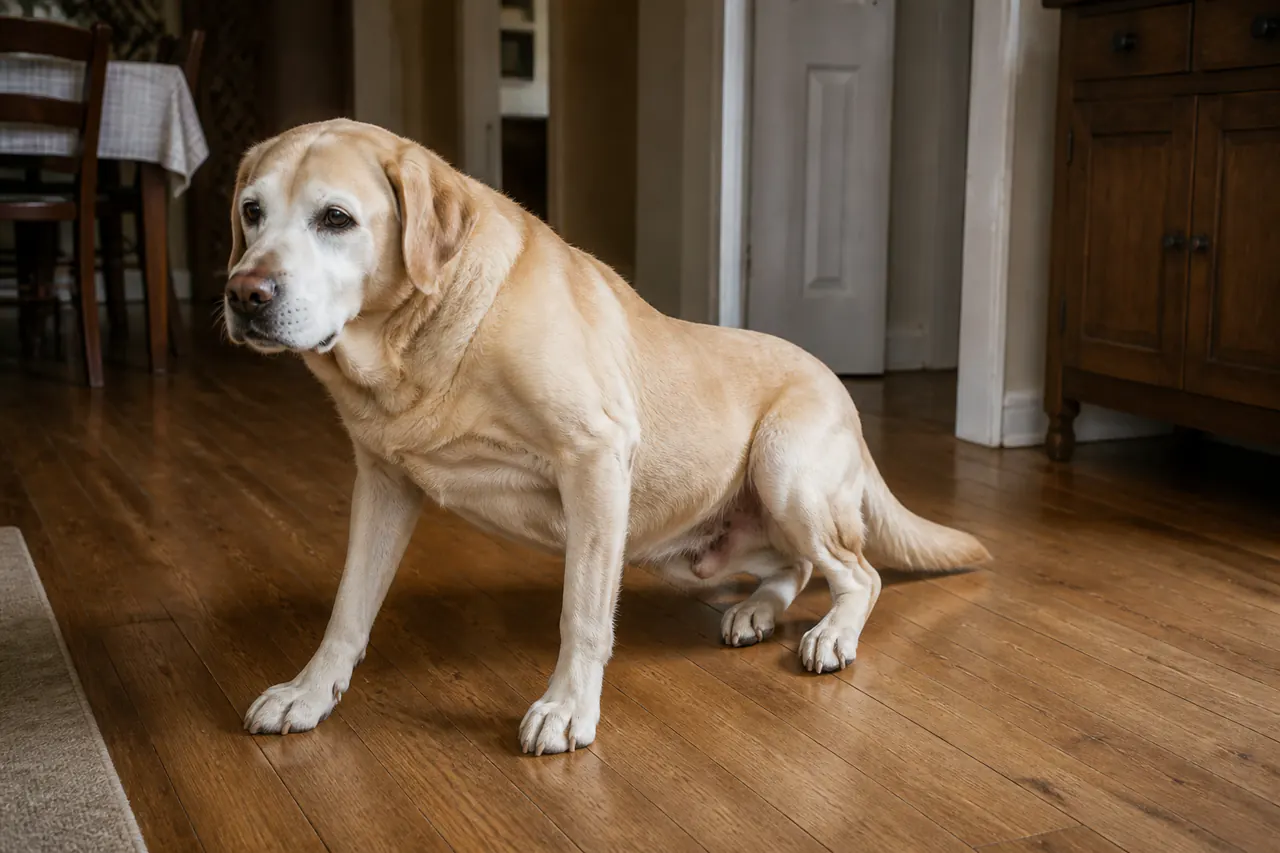
When an owner tells me their dog is slowing down, they usually mean the joints. Often they're right. But the thing that turns up over and over in dogs whose owners came in worried about arthritis is that the dog has quietly lost a significant amount of muscle.
Dogs lose lean body mass as they age. AAHA states it without hedging:
"Dogs tend to lose LBM and gain fat as seniors and incur overall weight loss with advanced age."
2023 AAHA Senior Care Guidelines
Read the first half of that twice. Lose muscle and gain fat.
Which means the scale can sit perfectly still while the composition of your dog changes underneath it. They weigh what they weighed last year. They are not made of the same thing they were made of last year.
And muscle is not cosmetic. It is how they get off the floor. It is how they take the stairs. And it is what they have to draw on if they ever get ill enough to stop eating for a few days.
So what slows that loss?
Here I have to be careful, because this is exactly where the internet gets loud and the evidence gets thin.
AAHA's line is: "Senior pets, particularly cats, may need up to 50% more protein to improve or slow muscle loss."
Note the words "particularly cats." I am not going to hand you a cat number and call it a dog number. Plenty of people will.
For dogs specifically, here is the honest state of it. A 2026 review of protein requirements across canine life stages summarizes decades of work this way: protein restriction "is not necessary for healthy elderly dogs and these dogs may even have higher [protein requirements] than young adult dogs." The one study that actually quantified it in dogs, using muscle mass rather than the cruder methods available at the time, also landed on up to 50% more protein for older dogs than for adults.
That study is from 1966. It has never been properly repeated. The same review says plainly that for elderly dogs "there is a marked scarcity of scientific information on nutritional requirements," and I'd rather tell you that than pretend the science is tidier than it is.
The Purina Institute gives the practical version in one sentence:
"Inadequate protein intake increases the rate of loss of LBM in aging dogs, while abundant protein slows the loss."
Purina Institute
So the direction isn't really in dispute, even though the exact number is. Older dogs need at least as much protein as adult dogs, quite possibly meaningfully more, and restricting it in a healthy old dog has no basis at all.
Now hold that next to the first thing I told you.
Dr. Joseph Wakshlag, a board-certified veterinary nutritionist at Cornell, put it about as bluntly as anyone in the field is going to:
"Typically, we like to see slightly higher protein diets; however, many of the senior diets on the market are lower protein."
Dr. Joseph Wakshlag, Cornell Riney Canine Health Center
That is the whole problem in one sentence. The evidence points up. A good part of the aisle points down. And the word on the bag is not required to tell you which one you bought.
THE 30-SECOND CHECK
The check I would rather you did tonight
It's free, it takes about thirty seconds, and it is worth more to you than the bag is.
Body weight is not the measure. Muscle is. Veterinarians assess this with something called a muscle condition score, and the chart most of us use, published by the World Small Animal Veterinary Association, is a public document you can look at yourself.
You palpate four places. Not look. Palpate, with your fingers, through the coat.
- 1. Along both sides of the spine. The muscle here is where loss shows up first. You're feeling whether the spine sits down in a groove between two ridges of muscle, or whether the bone is the highest thing your fingers find.
- 2. The shoulder blades. They should feel padded. Not like plates under skin.
- 3. The skull, over the top and down the sides of the head.
- 4. The wings of the hips, the two bony points at the back.
The scoring is deliberately simple: normal, mild loss, moderate loss, severe loss.
And here is the part that surprises most owners. The WSAVA chart specifically notes that palpation matters most in the animals who look fine, because muscle loss can be happening independently of body fat. A dog can be at a perfectly good weight, or even carrying a little extra, and be losing muscle underneath it.
Do it tonight. Then do it once a month, on the same day, so you're comparing like with like. Whatever else you take from this article, take that one. It costs nothing and it is the earliest signal you have.
Three. What most owners do next is the thing that actually hurts dogs.
I can predict what a good number of people are going to do with everything I've just written, because I have watched them do it for years.
They are going to start putting real food in the bowl.
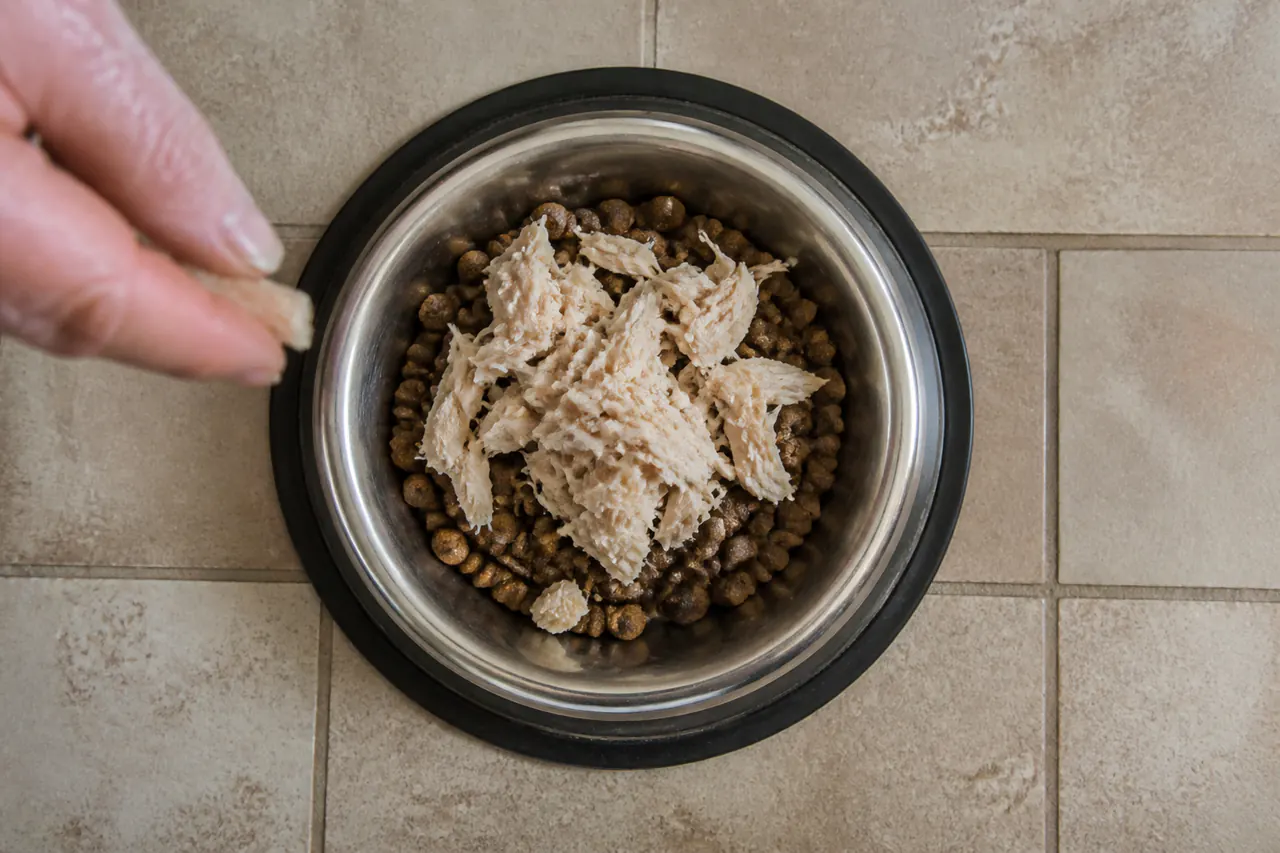
Chicken. Ground beef. An egg. Some of last night's roast. Not a whole homemade diet. Just a scoop of something real on top of the kibble, because they have just read that their old dog needs more protein and this is the obvious way to add some.
I understand it completely. And I need to slow you down, because this is precisely where good intentions do measurable harm.
Meat is protein. Meat is also, nutritionally speaking, a very lopsided food. It is high in phosphorus and it contains almost no calcium.
A dog's diet needs those two in a fairly narrow band. The Merck Veterinary Manual puts the optimal calcium-to-phosphorus ratio at roughly 1.2 to 1.4 parts calcium for every 1 part phosphorus, with an allowable range of 1:1 to 2.1:1.
Muscle meat is nowhere near that. It runs the other way, and it runs there hard.
Merck states the consequence without softening it:
"Calcium deficiencies have occurred when feeding high- or all-meat diets high in phosphorus and low in calcium."
Merck Veterinary Manual
Here is why that matters even when you are, as you'd put it, only topping.
The complete food underneath is balanced. Somebody formulated it so the numbers land where they should. Every unbalanced thing you add on top dilutes that balance. A small amount is genuinely nothing. A large amount is a different diet, and nobody formulated it.
The working rule, and it's the one I give clients, is this:
Under that ceiling, the complete food underneath absorbs it and stays complete. Over it, you are no longer topping. You are feeding a homemade diet without realizing that's what you're doing, and without any of the things a homemade diet requires in order to be safe.
That crossover is the most common way I see a well-meaning owner do harm to a dog they love.
Not the people who cook properly and supplement properly. Not the people who never cook at all. The people in the middle, who added a little more each month because the dog liked it, and who would tell you in complete honesty that they feed kibble.
And nobody ever tells them where the line is.
That, more than anything else, is why I put my system in writing.
What I do instead
I am not against home-cooked food for old dogs. I feed it. I have fed it for years, and for a lot of senior dogs, particularly the fussy ones and the ones with unreliable stomachs, I think it is the better answer.
A recipe tells you what to cook. It does not tell you how much for your particular dog. It does not tell you what has to be added afterward, or in what quantity. It does not tell you what happens when the store is out of something. And it does not tell you how you would know whether any of it is working.
Those four things are the entire difference between home cooking that helps an old dog and home cooking that quietly costs your dog. They are also exactly the four things that free recipes, of which there are now effectively an infinite number, do not contain.
So I built the rest of it. A four-step method. One pot, about ten minutes of hands-on work, seven days of food, with the numbers attached: calories for your dog's weight, calcium in milligrams, the four things that go into the bowl after the heat is off, and a five-minute monthly check so you are never guessing whether it's working.
And it starts, deliberately, with the thing you can do tonight without changing their food at all. A measured topper, under that 10% ceiling, using what is already in your fridge. Most of my clients start there. A fair number never go any further, and that is a perfectly good place to stop.
If you want to see how it works, I've written the whole thing out.
Read: The 10-Minute Bowl Method
The four-part system I use with clients, written out in full. The calorie and calcium charts by body weight. The four things that go in after the heat is off. The substitution rules for when the store is out. The monthly check, and the log to keep it in.
▸ SHOW ME THE METHOD