Free Recipes Tell You What To Cook. They Don't Tell You How Much, What Goes In After The Heat Is Off, Or How You'd Know It's Working.
Those three, plus what to swap when the store is out of something, are the difference between home cooking that helps an old dog and home cooking that quietly costs him.
ByTessa Wrenford
✓ The four things that go in after the stove is off. Two of them are destroyed by cooking, and all four overlap, so a full dose of each is an overdose rather than extra insurance. Dosed together, in milligrams, by his body weight.
✓ Calories for a senior, not a four-year-old. A sixty-pound senior who naps eighteen hours a day does not eat what a sixty-pound adult eats. 85% of published recipes never raise the subject.
✓ You can start tonight without changing his food at all. The book opens with a measured topper you add to the bag already in your cupboard. Nothing to buy first.
✓ Sixty day money-back guarantee to decide,and you keep the book either way. One email to me, no form, no reason required.
Enter your email and I'll take you straight to checkout.
Because "probably fine" isn't good enough for him.
If your dog is over seven, you already know the look.
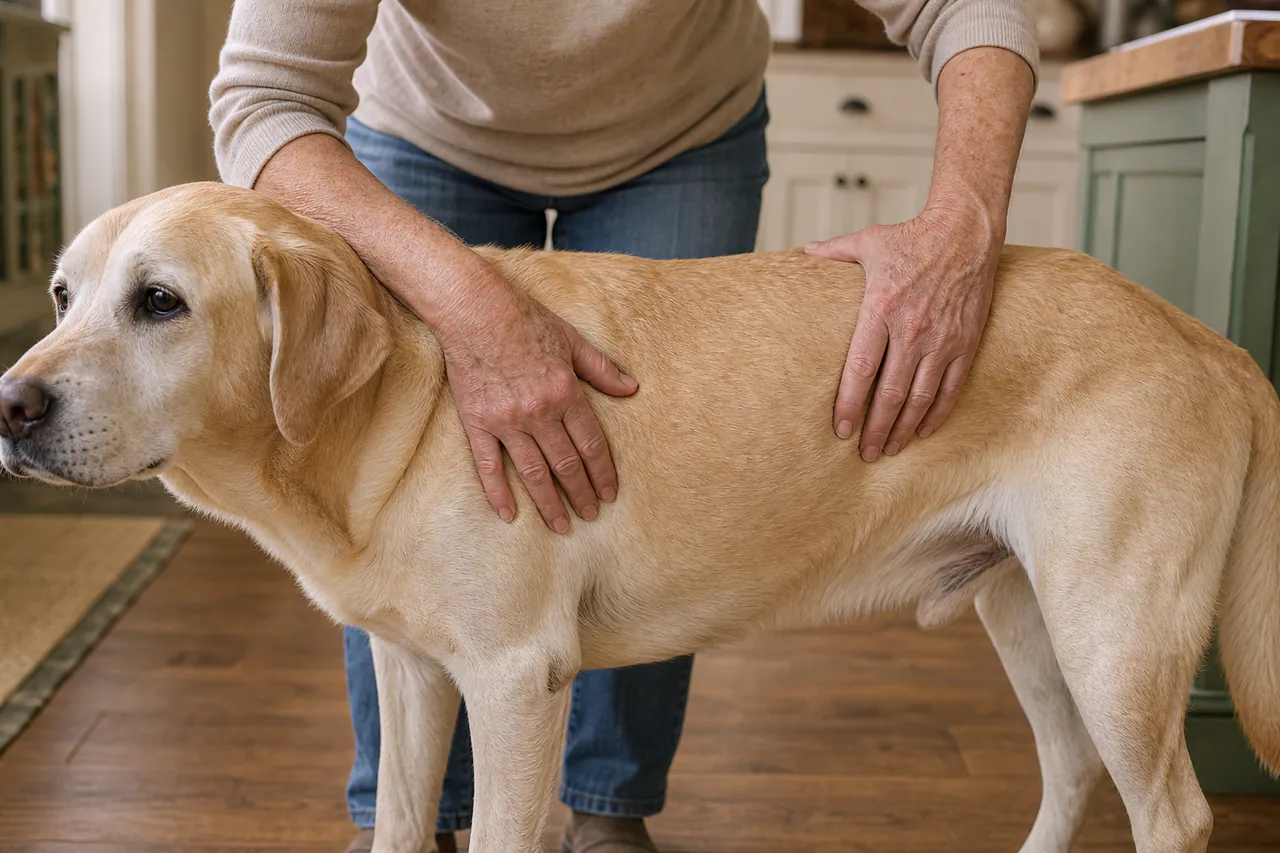
He gets up from the rug in two movements now instead of one. He takes the stairs like he's thinking about each one. He's still him — still at the door, still watching you cook — but something has downshifted, and you noticed it long before anyone else did.
And somewhere in the last few months you've had the thought that brought you to this page:
Maybe it's the food.
I want to tell you something the research doesn't say plainly enough:
You're right to ask.
But before I tell you what to do about it, I have to tell you about a dog named Gus.
Gus was a twelve-year-old shepherd mix. His owner — I'll call her Marlene — did everything a good owner does. She'd read that kibble wasn't enough for an old dog. She found a homemade recipe with four hundred saves on it, written by somebody kind and confident. Chicken, rice, carrots, peas, a spoon of olive oil.
She cooked it for him every single week for eleven months. She was proud of it. He loved it.
That spring, Marlene sought help because Gus wasn't getting up well. Arthritis was suspected, and there was some — but the bloodwork also raised concerns, and when the diet she'd been feeding him was run through a nutrient calculator, there it was.
That recipe had almost no calcium in it. And what little it had was swamped by the phosphorus in the chicken, in a ratio no dog should be eating for eleven months.
Here's the part I still think about.
Marlene had done more for that dog than most owners ever do. She cooked. Every week. For nearly a year. And the reason it went wrong wasn't that she was careless.
It's that nothing she'd been given had a number in it.
A recipe is not a diet
That case sent me down a road I'm still on. Here's what the research actually says.
In 2013, the veterinary nutrition team at UC Davis pulled 200 home-prepared dog food recipes from 34 different sources — websites, pet care books, and veterinary textbooks — and ran the nutrient math on every one.
95% were short on at least one essential nutrient.
83% were short on more than one.
Of 200 recipes, nine met AAFCO minimums. Five met the National Research Council's.
And then the two findings that almost never get quoted:
92% of the recipes had vague or incomplete instructions.
85% never told you how many calories were in the bowl.
In 2025, a much larger study in the American Journal of Veterinary Research looked at 1,726 homemade diets that real owners were actually feeding real dogs.
6% had the potential to be nutritionally complete.
Not 6% were complete. Six percent could have been — if everything else went right.
Now, I'm not telling you homemade food is dangerous. I feed it. I have for years.
What I'm telling you is narrower, and much more useful:
A recipe tells you what to cook. A diet tells you how much, how often, what has to be added, what happens when you swap something out, and how you'd know if it stopped working.
Recipes are free. There are ten thousand of them and more every day. That has never been the shortage.
The shortage is the four numbers underneath them.
The four numbers no free recipe gives you
1. Calcium, in milligrams, for your dog. A dog fed muscle meat, rice and vegetables gets a small fraction of the calcium he needs, and the shortfall doesn't announce itself for months. It also isn't one fixed number — calcium has to be judged against the phosphorus in that particular recipe, which is why "add a spoonful of crushed eggshell" is not an answer to anything.
2. Calories, for your dog. A twelve-year-old sixty-pound Labrador who naps eighteen hours a day does not eat what a four-year-old sixty-pound Labrador eats. Eighty-five percent of published recipes never raise the subject. "One to two cups" is not a portion. It's a shrug.
3. What happens when you substitute. The store's out of sweet potato, so you use white potato. The sardines looked expensive this week, so you skip them. Every one of those swaps feels like nothing at the time. Some of them genuinely are nothing. Some of them change the whole bowl. Nobody tells you which is which.
4. Whether it's working. This is the one that gets me. Not one free recipe I have ever read includes a way to check whether the dog is actually doing better on it.
And then there's the drift
Here's the finding that changed how I do this.
Veterinary nutritionists at Tufts surveyed owners who had been handed a properly formulated home-cooked diet — a real one, built by a board-certified nutritionist, the correct thing.
Of the thirty owners who could produce a complete diet history, four were still following it exactly. Thirteen percent. About one in seven.
The other twenty-six hadn't quit. They'd drifted. The store was out of one thing. The supplement ran out and didn't get reordered. The recipe got remembered instead of read. The portion got eyeballed instead of weighed.
I call it the drift, and it is the single most common way a good homemade diet turns into a bad one.
It doesn't announce itself. There is no day on which the food goes wrong. It just quietly stops being the thing you were told to feed — and by the time it shows up in the dog, it's been happening for a year.
Which is why, years ago, I stopped collecting recipes and built a system instead.
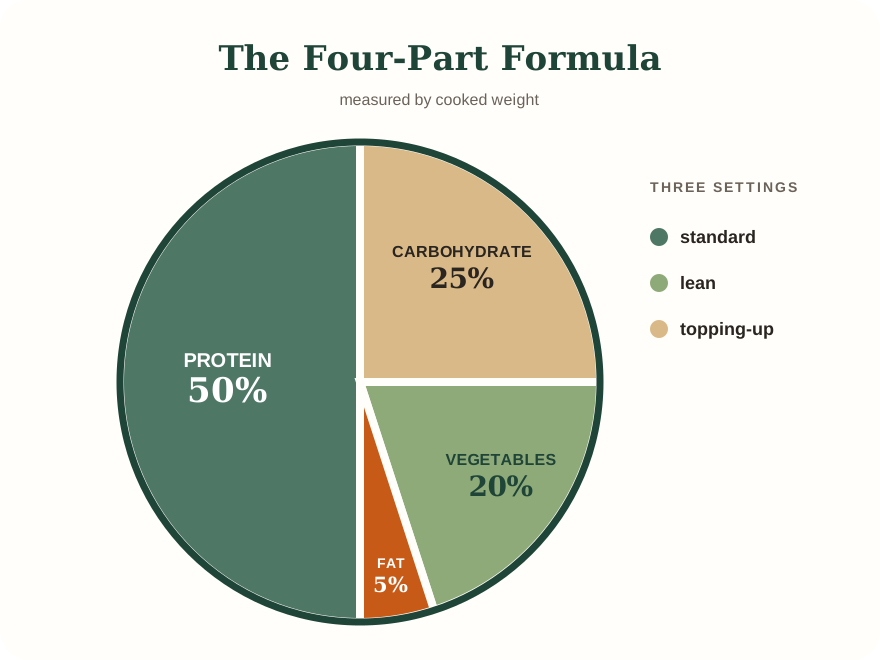
Three settings — standard, lean, and topping-up — depending on whether your dog needs to hold his weight, carry a little less of it, or is still eating some of his current food.
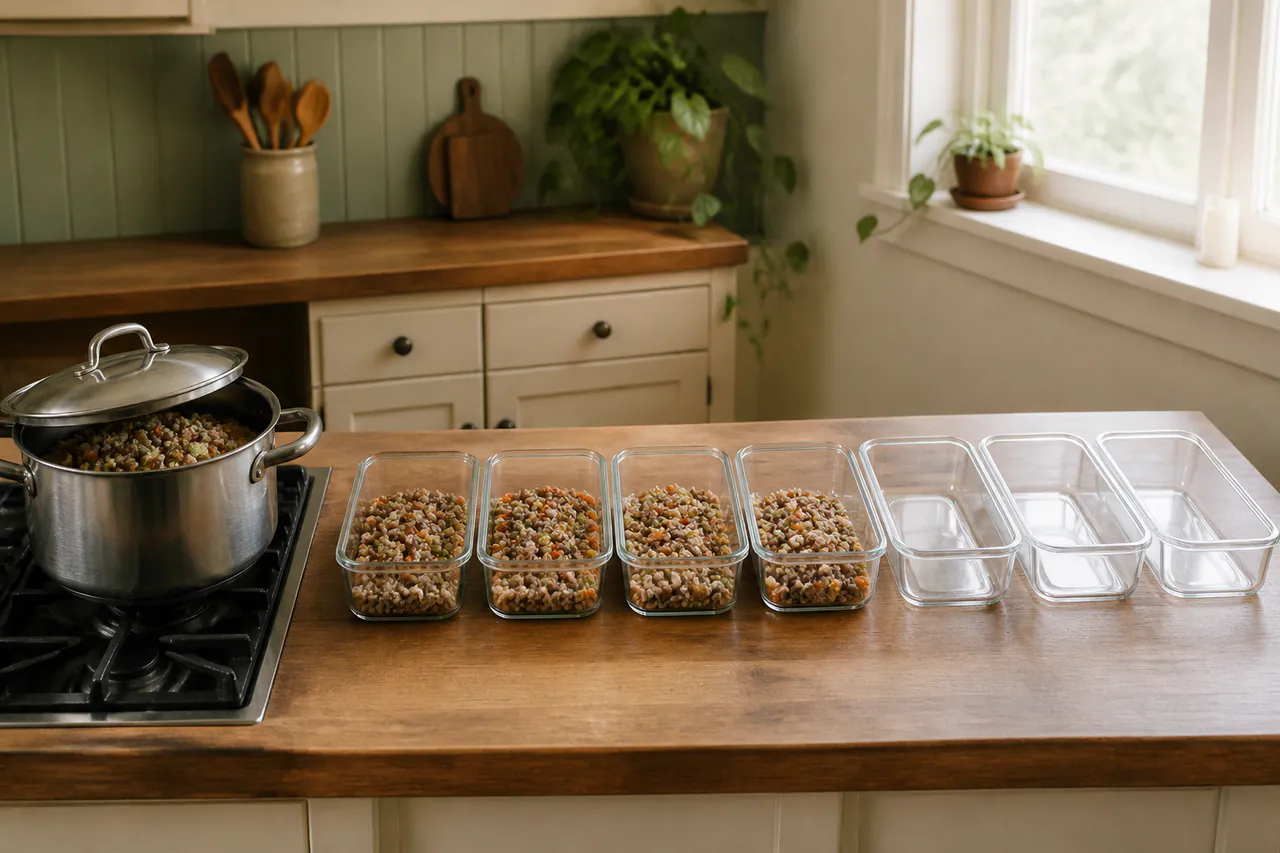
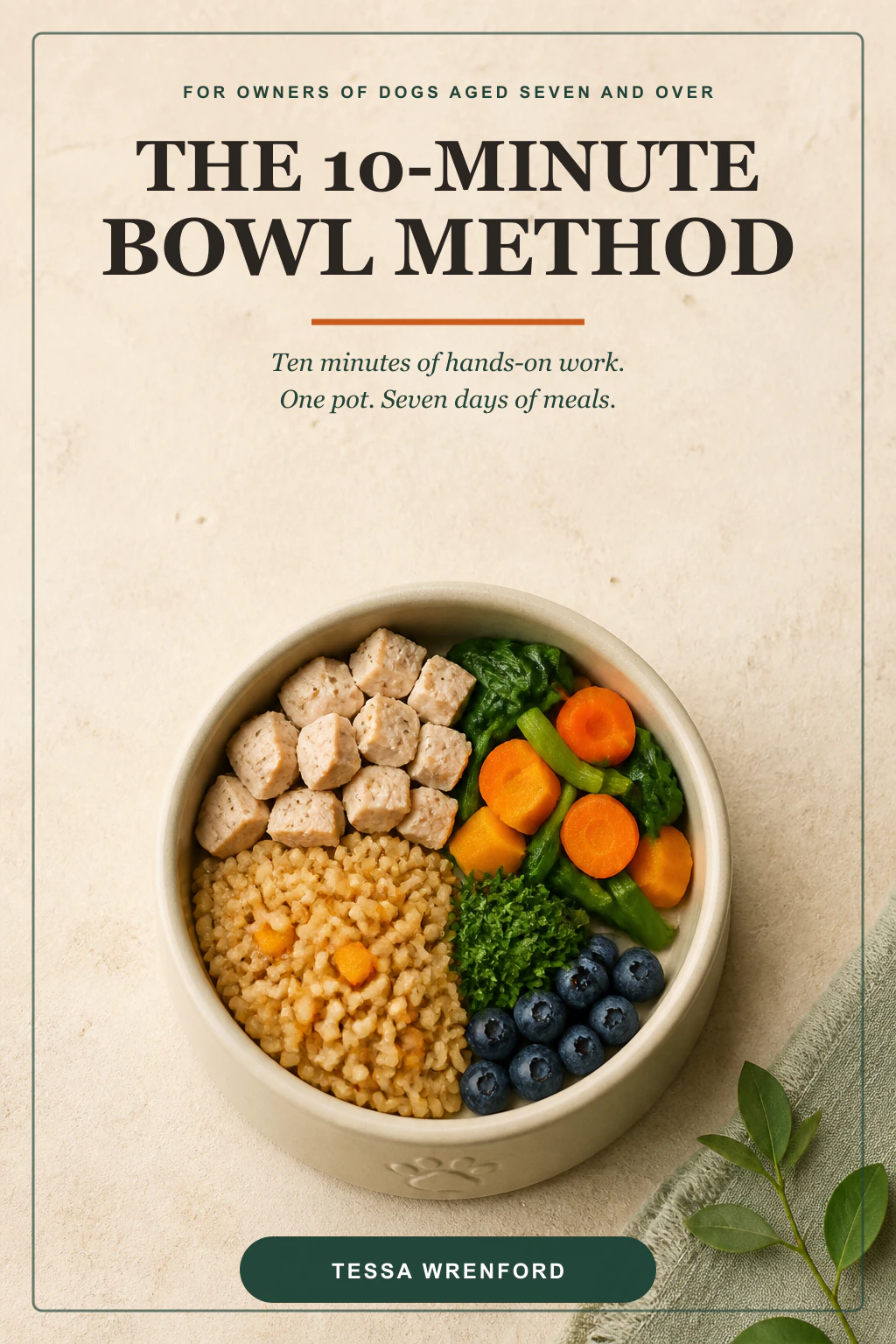
That's the entire cooking part. One pot. About ten minutes of hands-on work. Seven days of base food.
02
Step two — The Finish
This is the step that turns a meal into a diet, and it's the one thing I'd want you to take from this page even if you never buy a thing from me.
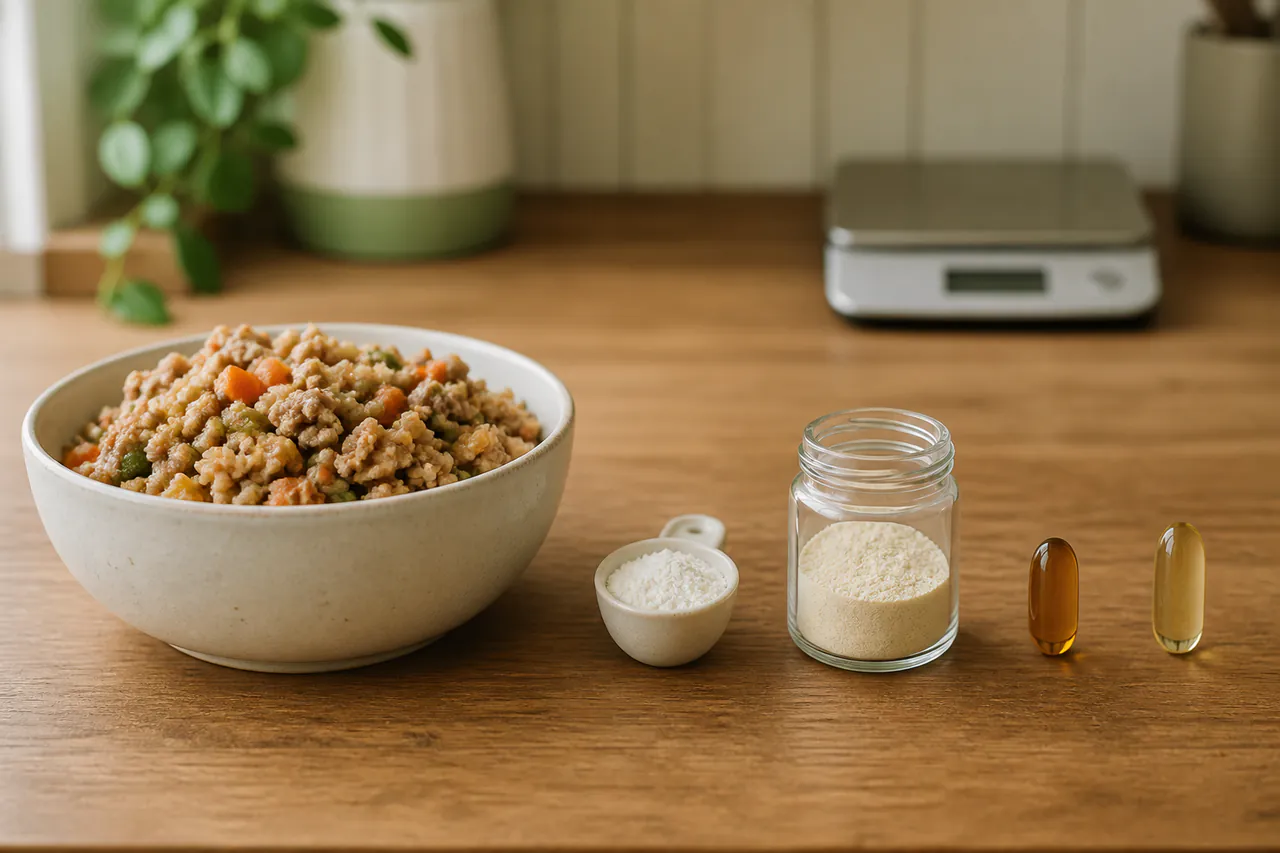
Nothing that matters goes in the pot. It goes in the bowl.
Four things go in off the heat, once the food has cooled: calcium, a complete balancer, EPA and DHA, and vitamin E.
Two of those four are the reason for the rule. The vitamins inside a balancer and the omega-3s in fish oil are both degraded by cooking — stir them into a simmering pot and you have largely wasted them. The other two go in off the heat because that's the only way to dose them accurately, which matters more than most people realise.
And here's the part that trips up owners who are genuinely trying: those four overlap. A good balancer already carries calcium and vitamin E. Adding a full dose of each on top of it isn't twice as safe — it's an overdose, and in an old dog, extra calcium is not a harmless mistake.
So the book doses the four together, as one finish, charted by your dog's body weight, and tells you exactly which forms to buy.
03
Step three — The Rotation
Three proteins on a three-week cycle, plus a green / yellow / red substitution rule, so that when the store is out of something you know in about four seconds whether you can swap it straight across, swap it with an adjustment, or not swap it at all.
This is the part that kills the drift.
04
Step four — The Monday Check
Five minutes. Once a month. Weight, body condition, muscle condition, stool, water. There's a one-page log in the back.
Because "he seems fine" is not monitoring — and in an old dog, the changes that matter show up in muscle long before they show up in behavior.
That's it. Four steps.
No app. No subscription. No math you have to do more than once — because once your dog's numbers are written inside the front cover, you never do that part again.
I don't want you to switch his food tonight
I mean that literally.
One of the main reasons homemade feeding goes wrong is that people go all-in on a Sunday because something frightened them on a Saturday.
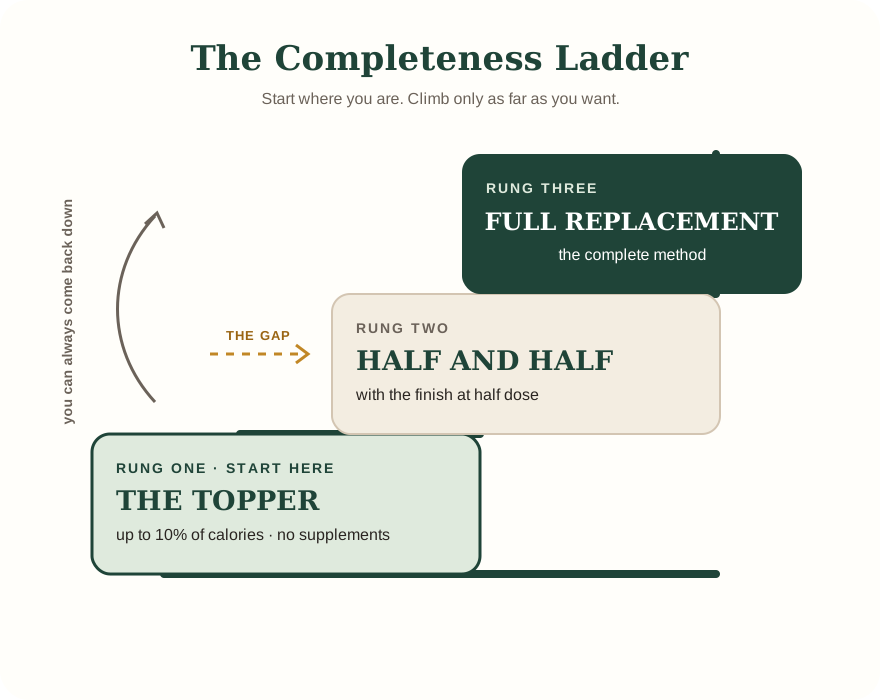
So the book opens with what I call the Completeness Ladder, and it has three rungs.
Rung one — the topper. You keep feeding exactly what you feed now, and you add a measured topper: up to 10% of his daily calories. Because it stays under that ceiling, it doesn't unbalance a complete food underneath it, and it needs no supplements. This is where most people start, and plenty of them never move. You can start it tonight with what's already in your fridge.
Rung two — half and half. Half his bowl homemade, half his current food, with the finish at half dose.
Rung three — full replacement. The complete method, running on its own.
And here's the part nobody tells you:
The dangerous place isn't rung one and it isn't rung three. It's the gap between them.
It's feeding forty percent homemade while still calling it "a topper" — enough to unbalance the food underneath it, not enough to be a diet in its own right. That version has no numbers on it at all, and it's the most common way people end up in the 95%.
The book names that gap in chapter 3 and gives you a fourteen-day transition with a stool check at every single step — so you always know whether to advance or hold.
You can also climb back down.
If this doesn't fit your week, or your dog decides he preferred the old stuff, you drop to rung one — or step off the ladder entirely. The kibble bag isn't going anywhere. Nothing here is a door that locks behind you.
Here's what happens when you open it tonight
In the first five minutes, you'll turn to the chart on page 59, find your dog's weight, and write down two numbers you have almost certainly never had before: how many calories he should be eating, and how many milligrams of calcium have to go into his food. Those two numbers are yours from then on.
Tonight, you'll be able to add a measured topper to the food already in your cupboard, using the safe list in chapter 3, without changing anything else about his routine.
By Sunday, you'll cook one pot. Ten minutes of hands-on work. It'll make seven days of base food, and it'll cost less than you're expecting.
By the second week, you'll be running the rotation — and when the store is out of sweet potato you'll know exactly what to do instead of standing in the aisle guessing.
By the end of the first month, you'll have run the Monday Check twice, you'll have two entries in the log, and for the first time you will know — not hope — whether what you're doing is working.
And somewhere in there, you'll stop having the low-grade worry that you might be doing this wrong. That's the part the method is built to resolve.
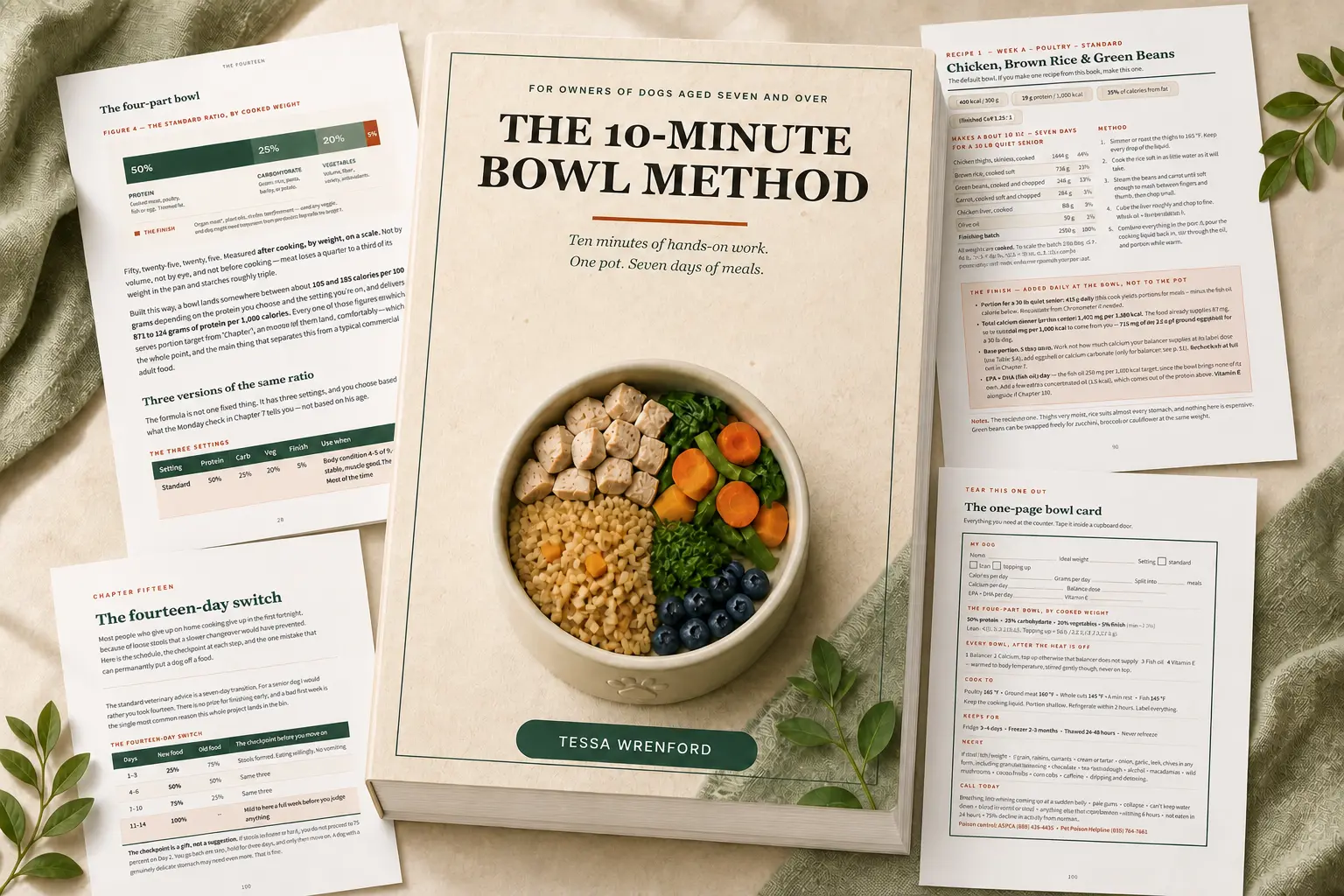
What's inside The 10-Minute Bowl Method
130PAGES
130 pages · instant download · print-formatted, large type, works on a phone or on a kitchen counter
▸ The Completeness Ladder — the three-rung on-ramp, so you can start tonight without changing his food at all, and climb only as far as you want to.
▸ The Four-Part Formula — all three settings, with worked examples for a 15-pound, a 45-pound and an 80-pound senior dog, so you see it done before you do it.
▸ The Finish, in milligrams — calcium, balancer+DHA and vitamin E, dosed together by body weight so nothing gets doubled, with the exact forms to buy and roughly what they run per month.
▸ Calcium by recipe, not by rule of thumb — because calcium is judged against the phosphorus in that specific bowl, and one blanket number would be wrong for most of them.
▸ Nine recipes with the numbers attached — calories per gram, grams per meal for your dog's weight, and the finish dosed for that particular recipe. Not "one to two cups."
▸ The 14-Day Transition, with a stool gate at every step, so an old stomach is never asked to do too much at once.
▸ The green / yellow / red substitution rules — the four-second answer when the store is out.
▸ The Monday Check and the one-page monthly log, including the muscle-condition check most owners have never been shown.
▸ The one-page vet handout — take it to your appointment. It states what you're feeding, at what calorie level, with what supplemented. This turns "my vet won't like this" into a conversation instead of an argument.
▸ Chapter 17: the nonsense list — the popular warnings that are simply wrong (avocado, tomatoes, grains, salt, raised bowls) and the handful that are deadly serious, with the doses that actually matter.
▸ Chapter 20: what I deliberately left out, and why — including the joint supplement that's in half the senior dog foods on the shelf.
▸ Chapter 21: which situation are you in — a one-page diagnostic for dogs carrying extra weight, dogs with stiff back ends, dogs with unreliable stomachs, and dogs whose bloodwork has started to shift. It tells you which situation you're in and what it changes about the base method.
A consultation with a board-certified veterinary nutritionist — which is the correct answer, and the one I recommend for any dog with a real diagnosis — runs around 575, plus roughly 300 more if the recipe needs reformulating later.
A custom-formulated cooked diet service will run you about $500 to formulate, then $600 to $900 for a four-week supply for a thirty-pound dog.
Fresh delivered food for a medium dog runs roughly $240 a month. Getting on for $2,900 a year.
And here's something the fresh-food companies will never put in an ad:
Cooking for your dog is not cheaper than kibble.
Real ingredients plus the finish run about $30 to $60 a month more than a decent mid-range bag. Anyone telling you otherwise is either selling you something or hasn't done their own grocery arithmetic.
What it is is roughly $80 to $150 a month less than having it delivered — and unlike the delivery box, you know every single thing that went into it, because you put it there.
The book is $27. Once.
I'd rather have ten thousand old dogs eating properly than a hundred.
Please don't buy this if
Your dog is under seven. Different calorie math, different priorities, different book. Wait.
Your dog has a diagnosed condition your vet is managing with a prescription diet. Kidney disease, pancreatitis, certain bladder stones, food-responsive gut disease — those diets are doing a specific job and you should not freelance around them. Print the vet handout, take it to your next appointment, and ask first.
You want me to tell you kibble is poison. I won't. There are excellent commercial diets, and this book says so plainly.
You're not going to measure anything. This whole system runs on a twelve-dollar kitchen scale. If you already know you won't weigh the food, then start at rung one and stay there — the topper chapter is the only part of this book you'll actually use, and I'd rather tell you that now than take your money and have you find out.
Sixty days. No conditions, no questions — because I'm not worried about it.
Read it. Use it. If it isn't what I told you it was, send one email to [email protected] inside sixty days and you'll have your $27 back. You don't have to explain yourself and there's no form to fill in.
Keep the book either way. I'd rather you had the calcium chart than had my twenty-seven dollars.
Two things I'm not going to tell you
I don't claim these recipes are "AAFCO complete."
AAFCO completeness is a formulation standard. You establish it by paying a veterinary nutritionist to formulate against it, or by running a feeding trial. I've done neither — and anyone selling you a twenty-seven-dollar recipe book who tells you otherwise is telling you something they can't back up.
Here's what I do claim, and it's stated in the front matter of the book:
Fed as written — the recipe plus the finish, at the calorie level the chart gives you for your dog — each recipe hits the calcium, calorie and calcium-to-phosphorus targets it was built around.
Change the recipe and you change that. Which is exactly why chapter 6 is about substitutions, and exactly why the green/yellow/red rules exist at all.
And I don't claim food fixes everything.
Food is one of four things that decide how an old dog's last years go. The other three are weight, movement, and catching problems early.
Food is the one you control three times a day, which is why I started here. It is not the whole job, and I'll show you the rest of it in time.
If you came looking for a miracle, this isn't it — and I'd be careful of anything sold to you as one.
The supplement I took out, and the one I left in
Let me give you a preview of the chapter people email me about.
Glucosamine and chondroitin are in roughly half the senior dog foods on the shelf and most of the joint chews at the register. In 2022, a systematic review and meta-analysis of the trials found they showed no measurable effect in 88.9% of them. The authors' own written recommendation was that those products "should no longer be recommended."
So they're not in this book. Not as a maybe, not as a "some owners find" — they're in the chapter called what I left out and why, alongside MSM, which as far as I can find has no canine trial evidence behind it at all, and one very popular "natural" ingredient I consider genuinely risky to put in a dog's bowl.
Omega-3s — EPA and DHA — came out the other way. Same review, same authors, same methods: only two of twenty trials failed to find an effect, and the authors concluded the evidence supported them.
That's why EPA and DHA are one of the four things in the finish, dosed in milligrams with a stated upper limit — and why glucosamine isn't in this book at all. What omega-3s will or won't do for one particular dog with one particular diagnosis is a conversation for you and your vet, not a promise from me.
If I'll take out the popular thing that doesn't work, you can trust what I left in.
One cook a week — about ten minutes of hands-on work while the pot does its part. Under two minutes to put a bowl together from the batch. Five minutes a month for the check. That's the honest answer, and it's exactly why the method is built around batching instead of cooking every night.
"My vet is going to hate this."
Some do, and usually for a good reason — they've seen the 95% problem walk into their own exam room. Which is precisely why there's a one-page handout in the back. It states what you're feeding, at what calorie level, and what it's supplemented with. Vets don't object to home cooking. They object to home cooking with no numbers attached. Hand them the numbers.
"Is homemade actually better than a good kibble?"
For a healthy dog on a genuinely good commercial diet — not automatically, no. What homemade gives you is control: over ingredient quality, over freshness, over exactly what your particular dog does and doesn't tolerate. For a lot of old dogs with fussy appetites or unreliable digestion, that control turns out to be worth a great deal. For some dogs the right answer is a good bag plus the rung-one topper, and the book says so plainly.
"What does the finish cost?"
For most dogs, somewhere between eight and twenty dollars a month depending on size. The book names the exact form of each of the four and tells you where to get it.
"My dog is overweight / has stiff hips / has a sensitive stomach / his bloodwork has started to change."
Chapter 21 is a one-page diagnostic that tells you which of those situations you're in and what it changes about the base method — the calorie setting, the protein choice, the transition pace. A full protocol for any one of them is its own thing, and for anything involving bloodwork, it's a conversation with your vet first.
"I have two dogs and they're different sizes."
Fine, and common. One pot, two portions — you'll have two calorie numbers and two calcium numbers. The finish is dosed by body weight, so it's the same batch with different scoops. There's a worked two-dog example in the transition chapter.
"What if he won't eat it?"
Old dogs are opinionated and it happens. The fourteen-day transition is deliberately slow partly for this reason, and there's a section on appetite in senior dogs — including the reasons a sudden refusal is a vet visit rather than a recipe problem.
"Is this a subscription? Will I be charged again?"
The book is twenty-seven dollars, one time. After you check out I'll show you a few optional things — a printable chart pack, condition-specific modules, and a membership that starts with a trial and then renews monthly unless you cancel. You can decline every one of them and the method in this book works exactly as I've described it. Anything that renews will say so, in plain English, before you agree to it.
"How do I actually get it?"
Enter your email, complete checkout, and it's on the next screen and in your inbox inside a minute or two. You'll get the PDF and a login for the members area. Nothing ships. Read it on a phone, a tablet, or print it and stand it on the counter, which is what I do.
The study I keep coming back to
Purina ran it over fourteen years. Forty-eight Labrador retrievers from seven litters, paired off against their own littermates. One group was free-fed — a full bowl, always down, the way an awful lot of dogs in this country are fed. The other group got twenty-five percent less, measured, for their whole lives.
The measured group lived a median of 13 years. The free-fed group, 11.2.
Nearly two extra years — from how much food went into the bowl.
But it's the companion paper on those same dogs I find harder to forget. They x-rayed their hips for the whole fourteen years.
In the free-fed group, the median age at which arthritis first appeared on film was six.
In the measured group, it was twelve.
Same litters. Same genetics. Same everything, except the bowl.
Now, I want to be careful with this, because it gets misused constantly.
That study is not an argument for cutting your old dog's food by a quarter. Please don't do that — in a senior dog, unintended weight loss and lost muscle are their own serious problem, and I'd rather you did nothing than did that.
It's an argument for measuring. Those dogs weren't starved. They were counted. The difference between a dog whose hips go at six and a dog whose hips go at twelve was that somebody knew the number.
I can't tell you a book will buy your dog two more years. Nobody can tell you that.
What that study does say is narrower, and I think more useful:
The bowl is not a small lever. It's one of the few large ones you still have — and it's the one you pull three times a day whether you're thinking about it or not.
Your dog has some number of Sundays left. Neither of us knows what that number is. Waiting never sends you a bill — it just takes the time.
So if you've been circling this for a while, opening recipes and closing the tab because something about them felt unfinished: that instinct was right. Something was missing. It was the numbers.
He's not going to ask you for this. He's just going to keep showing up at the kitchen door.
🔒 Secure checkout · Instant download · Refund within 60 days and keep the book
P.S. — If you take one thing from this entire page, take this: nothing that matters goes in the pot, it goes in the bowl. The balancer and the omega-3s don't survive cooking, and the calcium has to be dosed rather than guessed. If you already cook for your dog and you aren't finishing the bowl off the heat, please start — with me or without me.
P.P.S. — If your dog is over seven, still on kibble, and you have no intention of changing that, this book still has a job. Chapter 3 is the topper protocol: up to 10% of his calories, no supplements needed, and you can start it tonight with what's in your fridge. For some readers that chapter will be the whole reason to buy it.
P.P.P.S. — It's $27, it's a download, it's in your hands in about ninety seconds, and if it isn't what I told you it was you get your money back for sixty days, no questions, and you keep the book anyway.
Important. This book is educational material about canine nutrition. It is not veterinary advice, and it does not diagnose, treat, cure or prevent any disease. It is not a substitute for examination by your own veterinarian, who knows your dog. Do not change the diet of a dog with a diagnosed medical condition, or a dog on a therapeutic diet, without talking to your veterinarian first. Recipes are built to hit the calcium, calorie and calcium-to-phosphorus targets stated in the book when fed as written with the named additions; they are not formulated to, and are not claimed to meet, AAFCO or NRC completeness standards. If you believe your dog has eaten something toxic, call your veterinarian, the ASPCA Animal Poison Control Center at (888) 426-4435, or the Pet Poison Helpline at (855) 764-7661 immediately.